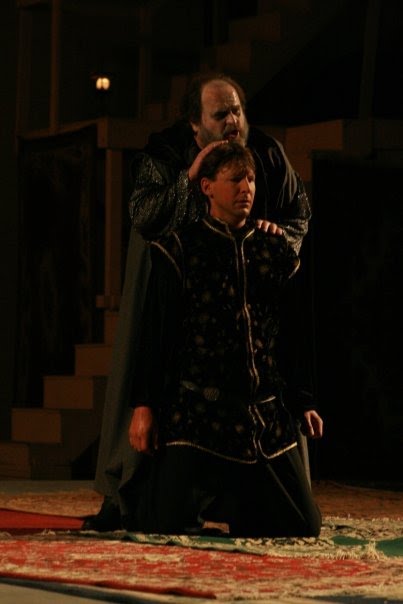
Tuesday, June 22, 2010

Brevity is the Soul of Wit

By Darcie Flansburg
The Real Critics Editor/Publisher

Love is accidental; it isn't something that you can really plan for. But in Heartland Players' production "Accidental Love," Kitty and Ken's relationship is entirely unexpected, at least for them.
The play was based on a short story by Danielle Peterson and was adapted for the stage by Dimyana Pelev.

The story is reminiscent of the 1987 Goldie Hawn and Kurt Russell film "Overboard."  A rich woman hits her head and forgets who she is long enough for a very poor man to take advantage of her new ignorance. But instead of falling overboard, Kitty (played by Pelev) gets into an accident in a taxi that Ken (played by Anthony Story) drives at night.

The play was very humorous causing the Saturday, June 19, audience to guffaw at the physical and verbal comedy.

Pelev created some wonderful Lucille Ball moments as she struggled to clean, cook and take care of children, things that the character had never experienced before. Her struggle to figure out the vacuum was particularly hilarious.

Story and Pelev Co-Directed the play, which was surprisingly successful. When actors direct themselves the pictures created on stage can feel clustered or ill interpreted, but Story and Pelev appropriately staged and performed the piece.

Story was very charming as the leading man, but at times he seemed to stumble through his lines.

Jeff Groff was excellent as Joey, Ken's best friend. Joey played along with Ken's story, aided him in all his needs, and provided necessary comedic relief when Ken was feeling down about the situation he had created. Joey's midnight breakdown scene, in particular, was a truly shining moment for Groff in the play.

Tracy Pelev played Joey's girlfriend/fiance Suzanne. Tracy has a strong stage presence but she tends to overact. Her verve is wonderful, but in an intimate space like Heartland Players emotions and personality need to be more finely tuned.

The cast was rounded out by Hannah Bunker as Isabelle, William Chinnock as Willy, Laura Johnson as Vickie and Krista Curtis as Lillian.

Pelev did a good job of scripting the show, keeping the play under 2 hours, including intermission. But the brevity of the story did leave some holes. For example, Ken's decision to pretend that he and Kitty were married was never evident. The first 15 minutes of the play shows Ken telling his nieces, nephews and Joey about the terrible woman that is now passed out on his couch. But when Kitty wakes up and demands an explanation Ken, out of nowhere, says that he and Kitty are married. This could have used more of a set up; Ken's continuous belittling of the unconscious Kitty made it seem like he just wanted her to get out of his house without suing him. So the 14-year marriage and children that Ken created not only blind-sided Kitty, but also the audience.

There was also the fact that Kitty's purse, with her real ID, was under the couch the entire time. It is hard to believe that she cleaned and redecorated the house from top to bottom and never found her purse until Joey, randomly, found it at the end of the play, after Kitty had already discovered Ken's plot.

There were a few other loose ends that could have used more explanation and/or time to develop, but Pelev did a good job of keeping the pacing of the play strong in both the script and on stage.
It is always a good sign when the audience is surprised when the lights come up for intermission; this means they were so engaged in the play that food, drinks or potty breaks are not on their minds. The Heartland Players' production of "Accidental Love" was well received by the audience and a sincerely enjoyable experience; well done!

Heartland Players presents "Dinner in .45" September 10 through 26. Visit www.heartlandplayers.org for details.

Friday, June 18, 2010

A Good Script Can Go A Long Way

By Darcie Flansburg
The Real Critics Editor/Publisher

A finalist for the Pulitzer Prize in 2005, "The Clean House" breaks the Play With Your Food Production conventions of producing knock-down, drag-out comedies. The script alone is a hearty venture; Sarah Ruhl's contemporary American stage comedy elicits both laughter and earnest tears.

Matilde is a maid who is saddened by the act of cleaning. Her parents were the funniest people in Brazil until they died; then the title fell upon Matilde. Not able to handle the pressure Matilde moved to America and happens upon the wrong house; a house where laughter is rare.

Matilde's boss Lane is a doctor, as is Lane's husband Charles. Lane is rarely home, but her sister, Virginia, is a housewife with time to spare. Soon enough Virginia is cleaning Lane's house and spending time with Matilde and they both learn some things about Lane's life that makes them all feel quite uncomfortable.

Annalice Heinz was enchanting as the jocular Matilde. Everything from her accent to the emotional ping-pong she emanated was not only entertaining, but touching. Theatre goers both during the show and after could not stop talking about "that maid" and how "lovely" she was. And it was true; I have seen Heinz on stage before and she never disappoints. There is something to be said for actors that study psychology, they know how to get into the mind of the character and beautifully transpose it onto the stage.

But Matilde isn't the only one with jokes. Virginia has the jokes that most of the audience can really relate to. Because the script is so well written a mild delivery of Virginia's lines would still evoke laughter, but there is still so much that can be done with the character.

Laurel Mueller was a strong choice for the part of Virginia; her delivery and presence were very natural on stage, but almost too casual. Mueller seemed more conscious of her own person than of the character that she was creating. She moved hesitantly on stage and didn't take many chances in her delivery or actions. There is a moment in the play when the very clean Virginia has a small breakdown and starts tearing the house apart. This was an opportunity for Mueller to really let loose, but her movements were stifled and for a moment it looked more like she was lightly rearranging small items in the main room rather than "making a mess."

Alicia Panicucci's performance as Lane was also somewhat constrained. Even after finding out that her husband was having an affair Panicucci's Lane seemed more conflicted than angry.

One of the aspects of Ruhl's style that was strongly maintained in this production was her focus on the inexplicable transformation of emotions. Heinz portrayed these transformations throughout the play, but Panicucci's shining moment was what I will call "the laughing/crying bit." Ruhl loves when plays have "revelations in the moment," which is what Lane experiences in this particular scene. The stage directions read "Lane cries. She laughs. She cries. She laughs. And this goes on for some time." It was in this moment that Panicucci showed true abandon as an actor, laughing and crying hysterically.

The cast was rounded out with Russ Rappel Schmid as Charles and Julie Stouse as Ana.

Stouse, like Heinz, accomplished a strong Portuguese accent and exuded a charm that made Charles' rash decisions plausible. Schmid and Stouse had great chemistry, not only as Ana and Charles, but also as the various ensemble characters they portrayed throughout the play.

But despite their chemistry, the couples love fizzled rather than climaxed toward the end of the play, unnecessarily. (*Spoiler Alert*) When Charles returns home with a yew tree for Ana, only to find that she has laughed herself to death Schmid should have exhaled a groan of utter despair and lost love, but instead he just seemed kind of disappointed. His expression seemed to say, "oh, dang."

Director Christopher "Kit" Fugrad used the stage well, but, at times, the blocking was stationary and unmotivated. This was, in part, due to the stage design and the limited space. Though the set design, by Laura and Murray Robitaille, was beautiful and pristine, the placement of the balcony made some of the blocking awkward. For example, when Matilde and Ana threw apples off the balcony and into "the sea," each one hit the stage with a thud that really pulled the audience out of the moment. Also the transitions between the house and the balcony were rather distracting.

But a good script can go a long way and despite minor shortcomings Play With Your Food Productions, under Fugrad's direction, presented a noteworthy show that kept it's audience laughing and invested in the story. The June 11 audience heartily laughed at Matilde's jokes, and Virginia's cleaning analogies, but also felt the pain of Lane's loss and understood the wisdom in the dramatic ironies presented in the plot. Play With Your Food Productions added this show to their season at the last minute and it was a worthy gamble.

Play With Your Food Productions opens it's 8th season with "Weekend Comedy" in October. Visit www.playwithyourfoodproductions.com for details.

Monday, June 7, 2010

Shakespeare, Chino and a Fat Pig

By Gabriel Morales
For the Real Critics Blog

Besides penning some of the most enduring and honored works of Western culture, Shakespeare explicated perfectly the purpose of his art. Through Hamlet’s command to an actor about to perform, Shakespeare says (in the easy-for-laypersons-to-read “No Fear” version): “Fit the action to the word and the word to the action. Act natural at all costs. Exaggeration has no place in the theater, where the purpose is to represent reality, holding a mirror up to virtue, to vice, and to the spirit of the times. If you handle this badly, it just makes ignorant people laugh while regular theater-goers [i.e. those who can recognize, understand, and appreciate good theatre] are miserable -- and they’re the ones you should be keeping happy” (Hamlet, 3.2).

The problem with straight theater -- especially straight community theater -- and the main reason for half-full houses on a good night is that, for the most part, this four century-old admonition goes unheeded. Yes, a fine orchestra, elaborate costumes and a realistic set are a joy to behold; but the true delight and purpose for theatre is the visceral symbiosis that occurs when an audience observes before them a person (whose steps, voice and very presence they can feel) living out the most dramatic moments of her life -- a goal impossible to achieve when the actor possesses neither the talent nor the fortitude to usher the viewers into that ethereal state where self-examination and catharsis are possible. But there’s always an exception to the community theatre rule... 

Through Neil LaBute’s refreshingly realistic dialogue, M. Michele Richardson’s savvy directing and the talents of a veritable dream team of a cast, Chino Community Theatre presents one of -- if not the only -- opportunities for IE theater-goers to this year experience that elusive and wholly satisfying glimpse into this zeitgeist’s looking glass. For just as the purpose of Hamlet’s play-within-the-play was to “catch the conscience of the king,” so too LaBute’s masterwork, “Fat Pig,” forces the post-modern audience to confront the brutal reality of their disgusts, prejudices and hatreds.

Richardson humbly credits the playwright for the production’s artistic success. LaBute’s brilliance notwithstanding, the director has shown delicate expertise in designing a lovely, ominous soundtrack, casting the play to perfection, and crafting the show’s effective pace and tone. If making a trite, anachronistic play entertaining is likened unto a running a marathon blindfolded, then directing a masterful, relevant play -- especially one that lives or dies by naturalistic performances -- such is the same race with a Faberge egg balanced on each palm; and, trust, Richardson crosses the finish line with treasures intact.

Then there’s the cast! An assembly of talent the magnitude of which is rarely seen ‘round these parts. Desiree Hill is splendid as “Helen,” the play’s namesake. Her rambunctious laugh, endearing personality, and inherent self-confidence all contribute to her vivid portrayal of society’s archetypal pariah. Hill’s training and experience are evident in the carefree way she successfully tackles realism. (My one critique being, I wish she had delved deeper into those few dark moments where Helen sees her fate foreshadowed and begins to crumble under the pressures of life and love.) Adam Demerath is marvelous as “Tom,” Hill’s lithe love interest. One of the IE’s most decorated and versatile thespians, Demerath can do it all: produce, direct, act, sing, construct, design, etc. -- is there such thing as an octuple threat? If so, Adam’s it. Apropos, when only burdened by the responsibilities of an actor as he is in “Pig,” Demerath creates a work of live art so layered, so focused, so enthralling, that the simple act of eating potato chips becomes a heart-wrenching illumination into the broken soul of the 21st century American man.

No less radiant is the supporting cast. National award-winning actor, Jeremy Magouirk, plays the hell out of the vulgar malapert “Carter,” best friend and foil to Demerath’s Tom. From a simple roar-inducing entrance, to a Cruise-inspired fit of couch jumping, to the somber recollection of a painful childhood memory -- Magouirk nails every moment, every pathos, thus making the most repugnant character understood, even winsome. The last of the talented quartet is Trista Olivas, who gives heart, humor and soul to “Jeannie,” Tom’s sultry, strong-willed ex-girlfriend, whom lesser actresses would relegate to a lascivious ditz or tyrannical misandrist. Unlike with Helen, LaBute doesn’t use dialogue to explore the irony of Jeannie’s name. The task falls to Olivas to embody both the male wish-fulfillment and self-destructive dreamer aspects of her post-modern American woman, which she readily accomplishes.

So... bad acting: audiences hate it (and too-oft rightly assume they’ll see it, and thus avoid patronizing local theaters) as it is the one unpardonable production sin -- the one mistake that should be avoided “at all costs.” Luckily, there’s the rare play (CCT’s wonderful “Fat Pig”!) where this is a non issue. Therefore, if you are among those few local patrons still spending their increasingly valuable income -- and infinitely more valuable time -- attending IE theatre, you would do yourself a great disservice by missing this show.

“Fat Pig” continues June 10 and 19 at 8 pm, and June 13 at 2:30 pm. Visit www.chinocommunitytheatre.org for details.

Sunday, June 6, 2010

'Without Vision These Shows Perished'

By Kellie McDonald
For the Real Critics Blog

Let me paint a picture for you that was this year’s Redlands Shakespeare Festival. Picture a large stage that is used for three shows -- Hamlet, Romeo and Juliet, and A Midsummer’s Night Dream. Above the stage it says “Without Vision a People Perish” unfortunately for this festival it should say “Without vision these shows perished.” At least that would have been a fair warning to the audiences for what they were about to witness.
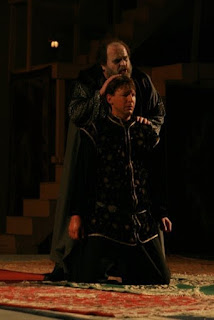
Now how do I introduce my thoughts on Hamlet? Maybe I should jump right in and get to the major issue that was the cause for all the other problems. Hamlet is an intense tragedy that takes the director, who takes the actors, and, in turn, they take the audience on an emotional journey. The artistic director of the festival, Steven Sabel, foolishly took on more than he could handle. Sabel not only directed the show (And A Midsummer’s Night Dream... we'll get to that later), he also did the fight choreography, and cast himself as Hamlet. There are very few cases where a performance is decent, let alone enjoyable, when the director is the main character in the show. There are even fewer cases where a forty-year-old man playing Hamlet could be conceived as a good idea. Unfortunately this production of Hamlet does not fall into either one of those cases. I think it would be a great injustice to even start to comment on the actors for they weren’t even given a chance to have direction for their own personal performances. So the fact that they couldn’t find their lights, they had unmotivated blocking, they broke their own reality rules which they had created, was to no fault of their own because they were without direction. Some of the supporting characters acted as if they were in a happy musical verses a classic tragedy, and they all around seemed to have very little understanding of the text, but again, this should not be held against them.
Luckily the entire cast didn't seem as lost as their lead man. It was very clear that Tom Newman, who played Polonius, knew his role and the story. His energy came alive on stage and he brought appropriate humor that the audience understood.
Sabel delivered his lines over dramatically and milked every speech for every second he could. Shatner could have said those speeches faster and clearer than Sabel did. The only tragedy about this production was simply that it was done. The audience was giggling throughout the entire show. Sadly the most dramatic part of the production was when Horatio put his hood on right before the black out at the end of the show.
In the center of the stage they placed a huge throne. There are two parts of the show where anyone who knows the story of Hamlet expected the throne to be used; during the dumb show, because that is where a King would sit to watch the play, and at the end for the final dramatic fight. For the dumb show the King sat on the floor with everyone else. That was so frustrating to watch because a King would not sit on the floor let alone with all the people of his court. My frustration was then turned into great confusion as Hamlet tried to, what seemed to be, rape Ophelia in front of everyone while no one did a thing. Instead of the conversation being an aside between the two characters everyone sat there and watched with slight concern on their faces. At the end of the play when the dramatic fight happens I thought to myself, “Now they must have something planned for the throne, seeing how it is center stage and this is the end.” Sadly the King sat in it for a total of 30 seconds then stood up again. Why would they have something center stage that was never used? Maybe it had some deep meaning? Or maybe it was simply there just to take up space.
While watching all three shows on the stage with the added thrust I came to the conclusion that the stage was large enough for what they were trying to accomplish and the thrust was not necessary. Not only did they have enough space already but they were unable to have front lights for the thrust so all of the actors faces were covered in shadows. Seems pretty silly to me if you’re trying to bring the action closer to the audience, yet, by doing so, you only make it harder to see their faces.
The second show I saw in the festival was Romeo and Juliet, directed by Ron Milts. Going into this show I felt confident that it could not be nearly be as awful as Hamlet because it had a different director. It was not as bad as Hamlet, but it was not good by any means. The acting over all was a step up from the previous show. Again some of the actors acted as if they were in an upbeat musical. There were several females who, yes, created character voices but with no help to keep their voices from making the audience’s ears bleed. Romeo and Juliet are one of the most famous tragic lovers in literature. Unfortunately the audience could not help but chuckle through their misery.
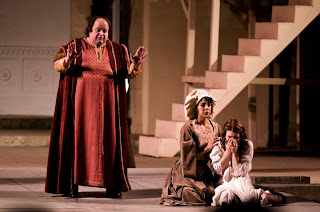
If I was to ask anyone (whether they knew the show or not) what is the first thing you think of when you hear the title of the play, Romeo and Juliet? They would answer “Oh Romeo, Romeo. Where for art thou Romeo?” The balcony scene is probably the most thought of scene in the play. On the stage were a total of four different platforms and where does Milts decide to have the balcony scene? On the end of the thrust, that is where. If you have several options that all could work very easily for the balcony scene, why on earth would you choose somewhere else?
Through the entire show they used the thrust as the balcony, which at least they were consistent about using the space as only one location. Oh wait, excuse me, it was the balcony through the whole show until the very end where without any notice the space became Juliet’s tomb. At first it seemed that her father just laid her “dead” body outside her room on her balcony. As an audience member for a few seconds, before I caught on that they were in her tomb, I found it believable that her father would just throw her dead body out her window, because earlier in the show he hit her and the actor created the feeling that he was an unbearable father. By having Juliet’s tomb on the thrust it meant the actress had to lay there close to the audience through the other scenes while she waited for the final scene to come. This took me out of the play completely and I just felt bad for the actress who had to lay there. This performance over all was pretty forgettable.
And last, but not least, A Midsummer’s Night Dream. This show had the audience laughing through the entire show. Luckily for the actors this show is supposed to be a comedy. For anyone who actually knows the show we were disappointed, but most of the unknowing audience seemed to be entertained (and that’s what really matters, right?). Again directed by Sabel this show fell short in many areas. The blocking consisted mostly of the actors either doing very poorly choreographed slapstick comedy or standing in a straight line talking to one another. The lovers were not in love with each other; they only were concerned with sex and the last time I checked love consisted of more than just lusting after another person. The actor who played Puck was more of a goof-ball instead of being mischievous so it was difficult to understand his motivation.
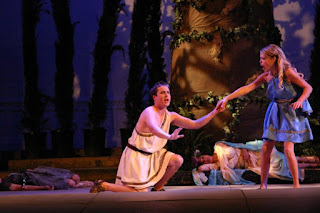
The slapstick comedy was not necessary through the whole show. The story alone is funny enough. To cover up the lack of knowledge of the script Sabel had the actors jumping over backwards to get laughs instead of just telling the story. It was obvious that no one payed attention to the text when Titania asked the fairies to sing her to sleep and instead of singing they just danced. If he was going to have them dance Sabel could have changed the text or cut the line entirely (it’s Shakespeare, and royalty free, so no one would blame, or notice, if you make such changes).
I can honestly say that the actors did do a great job of keeping up the energy and pace in this show. Also it was great seeing a couple scene changes, they showed the different worlds by using pillars for the court scenes and for the fantasy forest scenes they used the giant tree that was placed center stage. While in the forest, when some magic would happen, there was a laser sound effect that did not seem to ever be timed correctly with the actor’s moments. The sound effect was distracting and not necessary because the actors movements should have been enough to tell the audience magic was happening. On the counter side of that, while there was no dialogue on stage and magic was happening the background music was perfect and done very well.
If you don't mind two and a half hours of actors who sound like yapping dogs and giggling 12-year-olds, and sloppy slapstick comedy then this show was for you.
The Redlands Shakespeare Festival fell short all around in almost every aspect of theatre. As an honest reviewer I will acknowledge that the audience did seem to enjoy the shows and the majority of them stuck around through the entirety of the performances. When it comes down to it, yes, all the shows could have been MUCH better, but their audiences were entertained and that may be all that matters.

The Redlands Shakespeare Festival is an annual festival that produces three shows in May each year. Visit www.redlandsshakespearefestival.com for details.

Friday, May 28, 2010

Latest Footlighters Mystery Play is 'Unexpected'

By Darcie Flansburg
Real Critics Editor/Publisher

It is always enjoyable seeing an Agatha Christie play at the Redlands Footlighters Theatre. Not only are the plays well executed, but it is also amusing to hear the audience hum with suspicions and conjectures as the plot continues to twist and turn.
As would be expected of an Agatha Christie play, "The Unexpected Guest" is, well, unexpected. When Michael Starkwedder (played by Sean Green) has an accident with his car he walks into a house in search of a phone and instead finds a dead man. But Richard Warwick (played dead by Robert Spleen) was not the most noble gentleman during his life, which means that every family member, servant and recent visitor in his mansion has a motive for his murder.
Agatha Christie plays tend to have a great deal of front-loaded exposition. This means that right after the body is discovered at the beginning of the story two or more characters spend a good 10 minutes or so explaining a very complicated back-story in which every character is a suspect.
Amanda Vroom physically fit the part of the lovely Laura Warwick, wife to the late Richard, but her performance was a bit monotone especially during the exposition of the play, which killed the pace early on. She definitely portrayed the part of distraught wife well, but she showed no passion toward her lover nor did she reciprocate the flirtation from Starkwedder. Her performance exuded an emotional chorus consisting of one note.
Sean Green was very suave as the unexpected guest Michael Starkwedder. Though his British accent was faulty and his passion for Laura was unrequited, Green did a good job of being the dark horse who drove the action of the play.
Grant Markin was perfect as the poetic Sergeant Cadwallader. His accent was on point and his quirky qualities were well timed and well executed.
Ian McLean played the mentally challenged Jan Warwick with great authenticity. His character elicited love and compassion from the audience and later dire concern.
Sally Norton was excellent as Mrs. Warwick. Her stage presence reminded me of recent films of Queen Elizabeth; She was strong yet gentle, loving yet sensible. 
Thomik Deverien was very natural (and creepy) as the head servant Henry Angell. Deverien was ever present in his portrayal of Angell and moved with purpose; he portrayed a very proud and confident man despite his station.
The ensemble, as a whole, was strong, and well lead by new Footlighters Director Christopher Diehl. Despite the slow going exposition at the start of the play, the ensemble kept up the pace through the end of the show, which, of course, entails an ending that is entirely unexpected.
The cast also included Paige Polcene as Miss Bennett, Todd Paul Brown as Inspector Thomas, and Mike Barbin as Julian Farrar.
Set Designer Phillip Gabriel created a great ambiance with the set. The single room emanates grand luxury, alluding to the magnificence of the rest of the unseen mansion.
The Redlands Footlighters Theatre always produces well executed mystery plays and "The Unexpected Guest" is no exception.

"The Unexpected Guest" runs through May 30 at the Redlands Footlighters Theatre. Visit www.redlandsfootlighters.org for details.

'Celadine' is a Delight

By Vanessa Downs
For the Real Critics Blog

Nestled in the new performance space for the 3 Theater Group, I waited in anticipation for the performance of “Celadine,” a show I knew very little about. Nevertheless, I was more than pleasantly surprised with what unfolded before my eyes during the course of the next two hours.
Let me start off by saying that the 3 Theater Group’s new performance space is like a hidden treasure for theater goers, found within the Mission Galleria Antique shop. Dazzled by the various antiques and bits of history on the first floor of the shop, I was grateful for the signs that directed me upstairs to the theater.  Upon reaching the appropriate floor, I passed through the red curtains into the new theater. The space is still very much a work in progress, but all the necessary pieces are present.  The set was a very well done representation of the 17th century coffee house it was supposed to be. Haibo Yu was the Scenic Designer for the show, and the attention to detail was incredible. On either side of the stage were depictions of the city, letting audience members know that this particular show took place in the heart of a big city. Sarah Jacques is also to be commended for painstakingly creating the faux wood finish that decorated the floor of the performing space. Also of note is the work David St. Pierre put into the lighting design of both the theater and the show itself. Various color notes outside the coffeehouse window were clear indicators of the time of day and helped to set the mood of the show.
The show itself is about the intertwining lives of Celadine (Alisa Ann Lovas), a playwright; her closest friend Mary (Rhiannon Cowles), a reformed prostitute; and the King of England (Paul Jacques), a man moonlighting as Rowley.  Within this triangle, comes the recent introduction of Jeffrey (Winston Peacock), a mute; and Elliot (Majd Murad), an actor and spy. 
Celadine has not written a play for quite some time and is struggling to come to terms with the horrific death of her daughter. The coffeehouse she operates with Mary is struggling for money, adding to the sorrow that lays beneath the surface of the play.
The play begins with Mary sleepily descending the stairs in order to answer the door.  Cowles commands the stage with her portrayal of Mary. Her stance and facial expressions were spot on for a woman who had not been afforded the opportunities of the upper class, allowing the audience to become completely immersed in the moment, believing that, yes, we were peeping in on a real London coffeehouse. Shortly after Mary has woken up, Celadine returns home after a long night, riding her horse. Much to my surprise and delight, Celadine’s horse was actually Jeffery.  Peacock did incredibly well as a boyish mute, conveying the feelings of his character through actions alone. Jeffery and Celadine’s turn about the stage was the first indicator of the easy humor that was to run throughout the course of the show.
“Celadine” is part of a trilogy of plays written by Charles Evered, a new and talented playwright . Celadine, in an effort to be at peace with the death of her daughter, the illegitimate child of the king, asks that Rowley (The King) to claim that the daughter is his by giving her the royal last name. Rowley will only do this if Celadine will perform a duty for him: deliver a notebook and observe the man who takes it. Meanwhile, Celadine has met a new actor, Elliot, who is encouraging her to begin writing again. Celadine writes the story of her daughter and her tragic death, allowing audiences to discover just what happened all those years ago. During her writing process, Celadine begins to have feelings for Elliot, however, shortly after it is discovered that Elliot is the Dutch spy plotting to kill the king. All of the tension comes to a head during the fight scene at the end of the play. Elliot is apprehended, Celadine is at peace with the death of her daughter, and the king lives to see another day.
Though the play was full of humor, there was a depth and sadness to it that is not often seen onstage. Lovas was perfect for the part of Celadine. From the moment she enters the stage all eyes are on her. She is a superb actor, at her best during the parts of the show where she is remembering her daughter.  Thinking back on the show, the point that stands out to me the most is Lovas' voice; Clear, deep, and womanly, like ice cold water on a hot day. With her voice alone Lovas owned the character of Celadine, making her unforgettable. 
Lovas and Murad (Elliot) were perfectly cast together as the lovers. There was a palpable chemistry between the two that made the affection they had for each other believable, never stopping the audience from becoming fully submerged within the play. Jacques did well as Rowley, deftly conveying the passion and regal nature of a king.
Overall, the show was a delight and one that deserves the highest commendation.

Saturday, May 22, 2010

'Nude' Exposes More Than a Lack of Objectivity

By Darcie Flansburg
The Real Critics Editor/Publisher

Playwright Laura Shamas endeavored to answer some thought-provoking questions about artistic expression versus political correctness in her 1995 play "Portrait of a Nude."
The play traces issues of censorship, political correctness and aesthetics surrounding Francisco Goya's 1798 painting "Naked Maja." As Shamas put it, the play follows "the history of response to Francisco Goya's masterpiece 'Naked Maja' from the time of its inception in 1798 in Spain to the recent sexual harassment case surrounding it in 1991 at an American university."
All of the events in the play are based on real events, which leads Shamas to ask "is our response to art really based on the work itself, or on the 'politically correct' values of our times?"
Shamas believes our response to art is subjective, which is why the "Naked Maja" caused such tension between artistic expression and social propriety, as one critic put it.
Riverside Community Player's production of "Portrait of a Nude" presented Shamas' vision with great ardor. Director Kathryn L. Gage cast a strong group of actors that were able to portray everything from Goya to Princess Diana to schoolboys and clerks, all using a variety of accents to accomplish their many roles.
Mel Chadwick played Goya, the writer Zola, a museum guard and Dean of a university. Chadwick is a regular at the Redlands Footlighters theatre and is best known for his comedic ability on stage, but in "Portrait" Chadwick showed a comedic lightheartedness as Goya, a political passion as Zola and then transpired into a genuine realness in his other roles.
Phillip Gabriel is a master of accents and comedic timing. His portrayal of the Spanish inquisitor was harsh and demeaning while his portrayal of the painter Manet was capricious and yet full of conviction. Gabriel showed his campy side as the schoolboy and brought out his inner frat boy as one of the university students.
Kevin Bray was equally harsh and demeaning as the other Spanish inquisitor, but he was able to show his passionate side as poet Baudelaire and as the Spanish Official. Sue Bray was perfectly seductive as Maria, the subject of Goya's painting, and also showed an earnestness as Princess Diana and a vehement passion as the university campus Affirmative Action representative. And Rory Dyer rounded out the cast as the good intentioned university professor as well as the salacious Victorine, the subject of Manet's painting, influenced by Goya.
Though some of the accents could have been stronger, the ensemble presented a range of talent in a variety of roles that really showed all of their stage ability.
The show included projections of the paintings and pictures of the places being referenced in the play, during the minimal set changes. And Technical Director Tom Hurst and Costume Coordinators Rory and Ted Dyer provided a smooth and aesthetic presentation of the many settings.
The production exhibited pure professionalism; from the acting to the direction to the tech, the show was captivating and well executed. I was engaged, entertained and enlightened by this production; a truly magnificent work of art.

"Portrait of a Nude," runs through May 30. Visit www.riversidecommunityplayers.com for details.